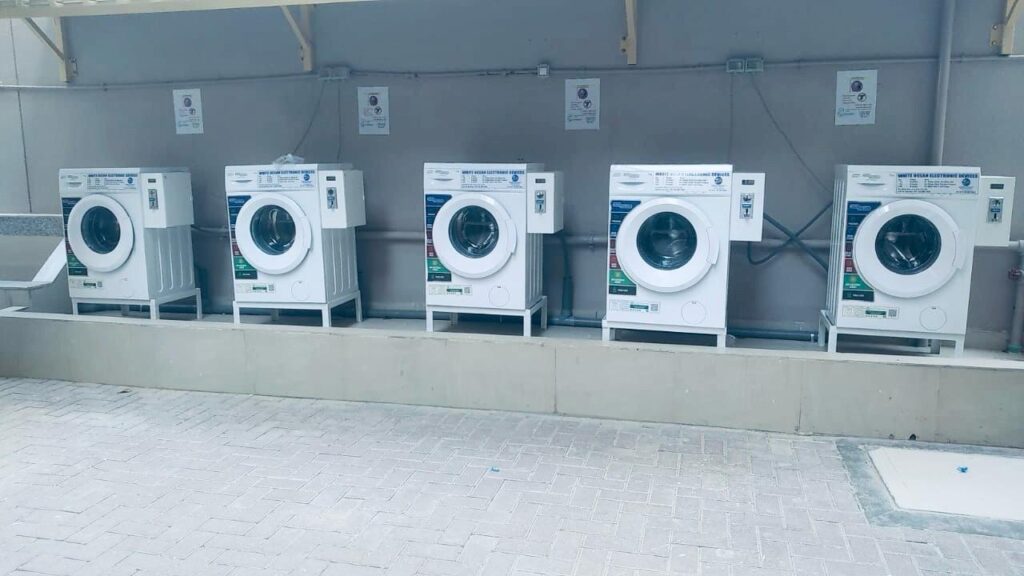
If you manage a labor camp in the UAE — whether it houses 50 workers or 5,000 — laundry is a daily operational challenge that most camp managers underestimate until it becomes a source of worker complaints, facility damage, and lost revenue. Providing proper coin-operated laundry facilities is one of the best investments a camp operator can make: it generates revenue, improves worker welfare, reduces water wastage from hand-washing, and removes a legitimate grievance from the camp environment.
But choosing the right machines for a labor camp environment is not the same as choosing machines for a public laundromat or hotel. Camp environments are harder on machines — heavy daily use, mixed fabric types including workwear and overalls, workers who may not follow machine instructions carefully, and minimal supervision. This guide helps you select machines that can handle the real demands of UAE labor camp laundry.
Understanding the Demand: How Many Machines Do You Need?
The most common mistake camp operators make is underestimating machine count. Insufficient machines create queues, worker frustration, and unofficial alternatives like hand-washing in rooms (which causes drainage problems and damp conditions). The general rule is:
| Camp Population | Recommended Coin Washers | Recommended Dryers |
|---|---|---|
| 50–100 workers | 3–5 machines | 2–3 dryers |
| 100–300 workers | 5–12 machines | 4–8 dryers |
| 300–700 workers | 12–25 machines | 8–15 dryers |
| 700–1,500 workers | 25–45 machines | 15–25 dryers |
| 1,500+ workers | 45+ machines | 25+ dryers |
These numbers assume staggered shift patterns where not all workers wash on the same day. If workers share a single shift and tend to do laundry at similar times (e.g., all returning from a construction site on the same evening), increase machine count by 20–30%.
Machine Types: What Works in Labor Camps?
Three machine types are typically used in UAE labor camp laundry rooms, each with distinct characteristics suited to different parts of the operation:
1. Coin-Operated Front-Load Washers (6–10 kg)
These are the backbone of any camp laundry operation. Front-load coin washers offer the best balance of cleaning performance, water efficiency, and durability for individual worker loads.
Advantages for camp use:
- Lower water consumption per cycle — important for camps where utility costs are paid by the operator
- Better cleaning performance, especially for heavily soiled workwear with embedded dust and oil
- High spin speed (1000–1200 RPM) extracts more water, reducing drying time and energy costs
- Front-access design allows machines to be placed against walls, maximising room efficiency
- Coin mechanism integration is cleaner and more tamper-resistant than on top-loaders
Considerations:
- Cycle time of 40–55 minutes is longer than top-loaders — plan machine count accordingly
- Workers need brief training to load correctly (don't overstuff, close door firmly)
Best for: All camp sizes as the primary washing machine type. Aim for 70–80% of your total machine count in front-loaders.
2. Coin-Operated Top-Load Washers (6–10 kg)
Top-load coin washers are simpler, faster, and often preferred by workers from certain cultural backgrounds who are more familiar with this style of machine.
Advantages for camp use:
- Faster cycle times (30–40 minutes) mean higher throughput during peak hours
- Simpler mechanism — fewer components that can fail in heavy-use environments
- Lower purchase cost compared to equivalent-capacity front-loaders
- Workers tend to find them easier to operate without instruction
Considerations:
- Higher water consumption per cycle
- Lower spin speeds mean wetter clothes out of the machine, requiring more drying time
- Agitator mechanism can be harder on delicate fabrics (less relevant for workwear)
Best for: Supplementary machines in large camps, or as the primary choice in smaller camps where speed of turnaround matters more than running costs.
3. Heavy-Duty Bulk Washers (18–25 kg)
One or two large-capacity washers handle the items that don't fit in standard machines: heavy overalls, blankets, sleeping mats, and bulk uniform washing. These machines are typically operator-controlled (not coin-operated) or set to a higher coin price.
Advantages for camp use:
- Handles items impossible to wash in standard machines
- Command higher pricing per cycle, improving revenue per square metre
- Reduces strain on smaller machines by handling oversized loads properly
Best for: Camps of 200+ workers where blankets and heavy workwear washing is needed regularly. Typically 1 bulk washer per 200 workers.
Coin System Options: Coins, Tokens, or Cards?
The payment mechanism is critical for a camp laundry operation. The three main options each have different implications for revenue security, operational convenience, and worker experience:
AED Coin Acceptors
The most common choice. Configured to accept 1 AED or 50 fils coins, with multiple coin insertion for higher-priced cycles. Simple for workers to use, requires coin collection and counting, and presents some risk of coin theft if boxes are not properly secured. Our coin acceptors come with high-security lockable coin boxes to mitigate this.
Token Systems
Camp management issues or sells tokens to workers, which they insert into machines. This eliminates the risk of real currency in machines, simplifies revenue tracking (tokens sold = revenue), and allows pricing to be set at non-coin increments. The downside is the administrative overhead of managing token sales and ensuring workers have tokens available when needed.
Prepaid Card / Timer Card Systems
Workers receive or purchase rechargeable cards. Swiping the card activates the machine for the paid cycle. This is the most modern approach, enables digital revenue tracking, and is highly tamper-resistant. Higher upfront cost for the card management system, and requires workers to keep their cards topped up. Works well in large, well-managed camps with IT infrastructure.
Our Recommendation: For most UAE labor camps, AED coin acceptors with high-security coin boxes are the most practical starting point. They are instantly familiar to workers, require no infrastructure, and generate predictable cash revenue. Add a coin counting machine to make revenue collection fast and accurate.
What to Look for in Machine Durability
Labor camp machines run harder than almost any other application. Here's what to insist on when evaluating machines:
- Stainless steel drum and outer tub — Prevents rust from salt-laden UAE air and high-mineral water, extends drum life by years
- Commercial-grade motor — Rated for continuous operation, not the intermittent use cycles of domestic machines
- Heavy-duty metal transmission (top-loaders) — Plastic transmissions fail quickly in heavy workwear applications
- High-capacity drain pump — Handles the lint and debris load from work clothing without frequent blockages
- Tamper-resistant coin box — High-security lock, steel construction, anti-drill hardened locking plate
- Field-repairable coin mechanism — Locally stockable spare parts, not proprietary systems requiring manufacturer service calls
Maintenance Planning: The Most Overlooked Factor
A 300-worker camp with 12 coin machines running 8 cycles per machine per day puts machines through 35,000+ cycles per year. That's equivalent to running a domestic machine continuously for 5–6 years, every year. Without planned maintenance, machines will fail frequently and expensively.
We strongly recommend an Annual Maintenance Contract (AMC) for all labor camp laundry installations. An AMC from White Ocean Electronic Devices includes:
- Scheduled preventive maintenance visits (machine servicing, drum cleaning, belt inspection, drain pump cleaning)
- Coin mechanism servicing and calibration
- Priority breakdown response — target response within 24 hours across UAE
- Parts availability from UAE stock — no waiting for overseas shipments
- Discounted rates on wear parts (belts, pumps, bearings)
Revenue Potential: What Can Camp Laundry Earn?
A labor camp laundry room is not just a cost centre — it's a revenue-generating facility. Here's a conservative calculation for a 300-worker camp with 12 coin machines:
- 12 machines × 8 cycles/day × 2 AED/cycle = 192 AED/day
- Monthly gross revenue = 5,760 AED
- After AMC, electricity, and water costs (~1,500 AED/month): Net ~4,000–4,500 AED/month
- Machine purchase amortisation over 7 years: ~600 AED/month
- Net profit: ~3,500–4,000 AED/month on a relatively passive basis
At this rate, a 12-machine installation costing approximately 45,000–60,000 AED pays back in under 18 months, after which the machines generate pure profit for 8+ years with proper maintenance.
Getting Started
White Ocean Electronic Devices specialises in labor camp laundry room design, machine supply, and installation across the UAE. Our process starts with a free site assessment — our team visits your camp, counts the worker population, assesses the space and utilities, and provides a tailored machine recommendation with full pricing.
We have machines in stock across UAE for fast delivery, and our installation team handles everything from plumbing connections to coin acceptor calibration and commissioning.